Setting Up Thunderbird 1.0.2
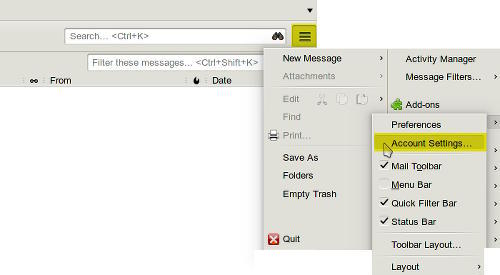
In the Tools menu, select Account Settings.

You'll see the SMTP (outgoing) email information. Fill in the Server Name
with mail.yourdomain.com where yourdomain.com should be replaced
with your actual domain name. Leave the Port as is unless you have problems
sending email, then you may want to change this number to 587 (see below). Check
the Use name and password option.
NOTE: If you plan to send email from more than one email account on your
domain, you may want to create and use a specific email account (or one of the
other email accounts) for sending email. This will then use this account for all
sending, and you'll still recieve email from each account separately, regardless.
Fill in your full email address of the account you wish to use for sending
email. Note the password for this account as you will need to enter it the first
time you go to send a message.

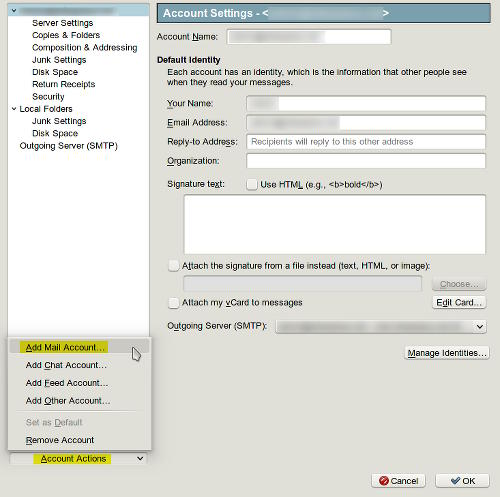
Click the Add Account button under the list box on the left.

Select E-mail account and click the Next button.

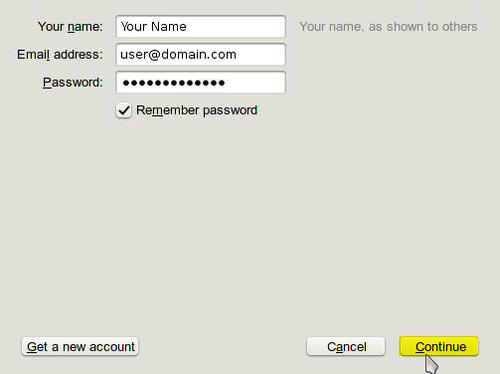
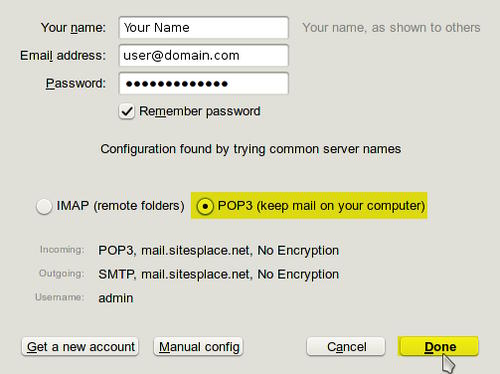
Fill in your name and your email address, then click the Next button.

Be sure POP is selected. The Incoming server should be something
like mail.yourdomain.com where yourdomain.com should be replaced
with your actual domain name. For the Global Inbox option, decide if you
want email from this account to appear in the same folders as other accounts set
up for Global Inbox or have a separate folder and listing of it's own.
If you want a separate folder for this account, uncheck the Global Inbox
check box. Otherwise all email from this account will be put into the Local
Folders folder in Thunderbird. Click the Next button when done.

Here you must fill in your entire email address in the box for the
Incoming User Name. This includes your email username, the @ sign and then
your actual domain name. Click the Next button.

Here you can fill in a descriptive name for this account so it is easy to recognize
in the list. Click the Next button. You will then see a list of all your
selected settings. Click the Finish button to create your account.

Your account is created. Now you can select more options under the account name
on the left, then on the right you can further customize your email account. For
example, here Servers is selected, and you can change when to retrieve
email, whether your trash folder is cleaned when you exit the program, and more.
Clicking the Advanced button will let you further customize settings such
as what folder (Global, etc.) to put your incoming email in, and which SMTP
server to use. Click the OK button when you're done.

How to Receive Email
Click on the arrow on the Get Mail button and then select the account you
wish to recieve mail for, or just click on the button itself to get mail from
all your accounts you have set up in Thunderbird.

How to Send Email
Click on the Write button. Now fill in the recipient's email address in
the To: field. you can also use the drop down box next to the field to
choose a different field, such as Carbon Copy (CC) or Blind Carbon Copy (BCC),
etc. If you start typing in one fo the fields below the To: field, you can add
more fields. Next fill in the Subject and finally compose your message.
When you're done, click on the Send button to send your email message.

Having Trouble Sending Email?
If you are having troubles sending Email, it may be due to your ISP locking the
SMTP port to use only their server. You can try using Active Web Hosting's
alternate SMTP port 587. If that doesn't work, you will have to use your ISP's
SMTP server and log in with your ISP username and password for SMTP or sending
mail only. You will need to contact your ISP for further instructions on setting
up your email client to use their SMTP port.
To set up Thunderbird to use a different SMTP port for your Active Web Hosting
account, follow these steps:
From the Tools Menu, select Account Settings...
On the left side, click on Outgoing Server (SMTP)
On the right side, type in 587 for the Port setting.
Now you should be able to send your Email via your domain's mail server. If this
does not work, contact your ISP to learn how to set your Email client up to send
from their SMTP server instead.
|